
The reflector is the small ball that sits on top of your FieldPrinter. The laser tracker never sees the robot — it sees the reflector. Everything the system knows about where your FieldPrinter is, and therefore where every line lands, comes from a laser beam bouncing off that one part and returning to the tracker.
Its industry name is a spherically mounted retroreflector, or SMR. Dusty's is a 1.5" SMR, called the Blue Ring Reflector in support cases and shipping paperwork. Everywhere else in this Help Center it's just "the reflector."
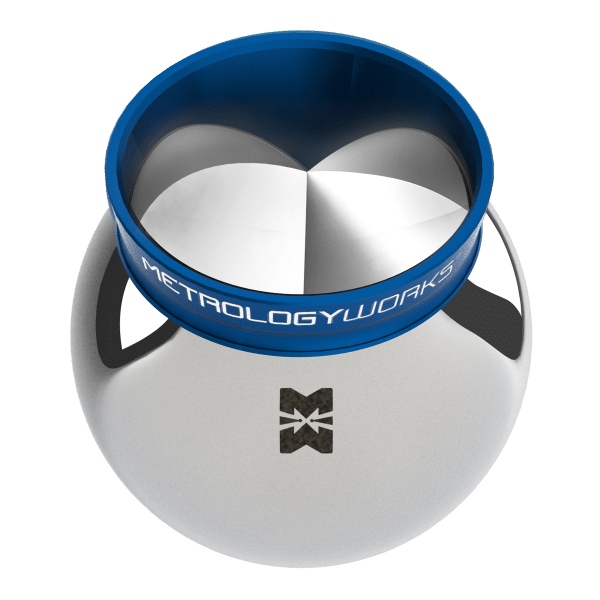
The three parts
| Part | What it is | What it does |
|---|---|---|
| The ball | The sphere you handle, machined to be nearly perfectly round. | Puts the optics at a fixed, known point — the exact center of the ball — so the tracker measures the same point no matter how the ball is rotated or which mount it sits in. |
| The corner cube | Three mirrored surfaces meeting at right angles, like the inside corner of a box. | Returns the laser beam parallel to the direction it arrived from, at any angle within its opening. |
| The reflective coating | A thin reflective layer on each of the corner cube's three surfaces. | Does the actual reflecting. It's the most delicate part of the assembly — a scratch, film, or clouded patch changes the beam the tracker gets back. |
Why a corner cube instead of a mirror
A flat mirror only sends the beam straight back if you hit it dead-on. Tilt it a few degrees and the beam goes somewhere else entirely.
A corner cube doesn't care about angle. Hit it anywhere inside its opening, from a wide range of directions, and the three mirrors bounce the beam between them and send it back parallel to the way it came in.
That property is the entire reason a laser tracker can follow a robot that's driving, turning, and crossing a slab. Without it, someone would have to keep a target aimed at the tracker by hand.
The returned beam comes back parallel but shifted slightly to the side of the outgoing one. The tracker reads that sideways shift to tell which way the reflector has moved, and steers itself to stay centered on it. That's what "locking on" means.
Why the ball has to be a sphere
The ball isn't packaging. Its shape is part of the measurement.
The optics sit at the geometric center of the sphere. Because a sphere looks identical from every direction, the tracker reads the same center point whether the ball is sitting in the reflector mount on the robot, resting on a control point target, or rotated to any orientation in between. You can move it between mounts and it still measures the same point.
This is also why seating matters. The system assumes the optical center is exactly where a fully seated ball puts it. A reflector that's tilted, partially seated, or rocking in the reflector mount puts that center somewhere else — and the tracker reports the resulting position just as confidently as a correct one.
How the tracker turns this into a position
The tracker measures two things about the reflector and combines them into a coordinate:
- Distance — how far away the reflector is, from the laser itself
- Angle — which direction it's pointing to reach the reflector
Both measurements are of the reflector, not of the robot and not of the mark on the floor. Anything that changes the returned beam — a scratch, a film of dust, mirrors knocked slightly out of square — changes what the tracker reads. In the mild case the tracker struggles to hold lock. In the worse case it locks, reports a stable number, and the number is wrong.
⚠️ Do not clean or disassemble the reflector. It's a precision optic, and the wrong cloth or solvent turns a recoverable reflector into a scrapped one. If yours is dirty, scratched, chipped, or has been dropped, contact Dusty for a swap.